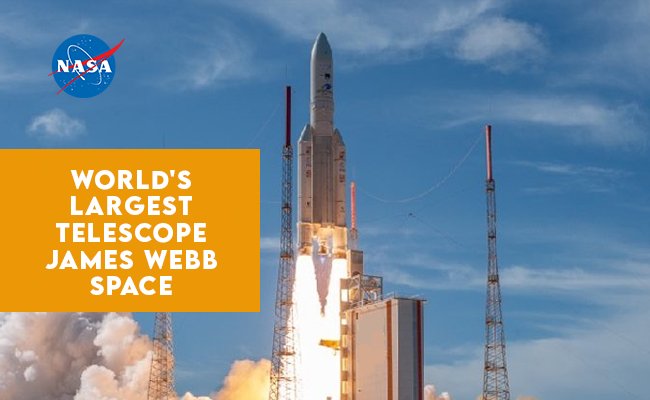
The world's largest and most powerful space telescope whizzed on a high-stakes quest to behold light from the first stars and galaxies. The launch marked the long-awaited start of the Webb telescope’s mission, after more than 30 years of development and countless delays.
NASA's James Webb Space Telescope rocketed from French Guiana on South America's north-eastern coast, riding a European Ariane rocket.
The Webb telescope’s primary gold-plated mirror measures more than 21 feet across, making it the largest to fly in space. The mirror’s size, which dwarfs the iconic Hubble Space Telescope and other existing space telescopes, gives Webb the sensitivity to see celestial objects that were previously undetectable.
The Webb telescope is designed to see beyond the range of the human eye and other telescopes that observe primarily visible light. Webb’s infrared vision can pierce through thick veils of cosmic gas and dust, allowing it to see celestial objects that might normally appear invisible to other observatories.
The $10 billion observatory rushed toward its destination one million miles away, or more than four times beyond the moon. It will take a month to get there and another five months before its infrared eyes are ready to start scanning the cosmos.
“It is going to give us a better understanding of our universe and our place in it, who we are, what we are, the search that’s eternal,” NASA Administrator Bill Nelson said.