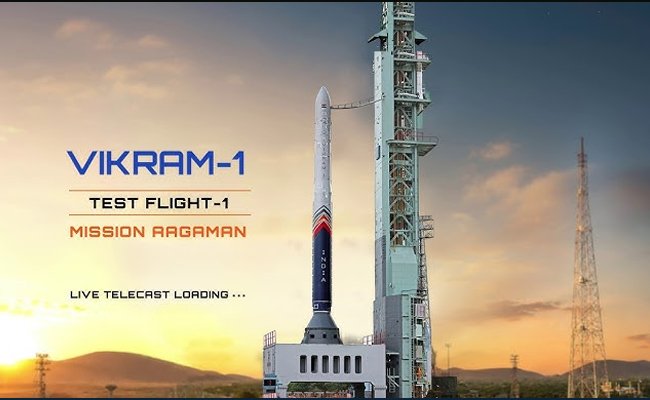
India has achieved a historic milestone in its space journey with the successful launch of Vikram-1, the country's first privately developed orbital rocket, by Hyderabad-based Skyroot Aerospace from the Satish Dhawan Space Centre in Sriharikota. The maiden mission, Mission Aagaman, successfully placed multiple payloads into a 450-km Low Earth Orbit, making Skyroot the first Indian private company to achieve orbital launch capability from Indian soil on its first attempt.
Standing approximately 22 meters tall, Vikram-1 is designed to carry payloads of up to 350 kilograms into Low Earth Orbit. The rocket incorporates several indigenous technologies, including 3D-printed rocket engines, advanced solid propulsion systems, and an orbital adjustment module, reflecting the rapid technological progress of India's private space sector. The mission also validated critical propulsion, guidance, navigation, telemetry, and flight control systems, paving the way for future commercial launches.
The achievement follows India's landmark space-sector reforms introduced in 2020, which opened the country's space ecosystem to private participation. Since then, startups such as Skyroot Aerospace have emerged as key contributors to India's ambitions of expanding its space economy from nearly $8 billion today to $44 billion by 2033, targeting a larger share of the rapidly growing global commercial launch market.
Vikram-1 carried multiple customer payloads and technology demonstration satellites, showcasing India's growing capability to deliver affordable launch services for domestic and international customers. The success also builds on Skyroot's earlier Vikram-S suborbital mission in 2022, demonstrating the company's ability to evolve from technology validation to full-fledged orbital launch capability.
The successful launch of Vikram-1 represents more than a technological achievement—it marks the beginning of a new commercial era for India's space industry. Until recently, orbital launches were almost exclusively the domain of national space agencies. With Vikram-1, India joins a select group of nations where private companies have independently developed and successfully launched orbital-class rockets, strengthening the country's position in the global NewSpace economy.
The mission also demonstrates the effectiveness of India's policy reforms that encouraged private investment while leveraging ISRO's infrastructure and technical ecosystem. Rather than competing with ISRO, private launch providers like Skyroot complement the national program by addressing the rapidly expanding market for small satellite launches, Earth observation, communications, defense, and scientific research. This collaborative model has the potential to accelerate innovation, attract international investment, and create a globally competitive space manufacturing ecosystem.
As demand for low-cost satellite launches continues to grow worldwide, India's combination of engineering talent, cost efficiency, and supportive policy could position the country as a preferred launch destination. Vikram-1 therefore symbolizes not just the success of one startup, but the emergence of India's private space industry as a strategic contributor to national technological leadership, economic growth, and global competitiveness.