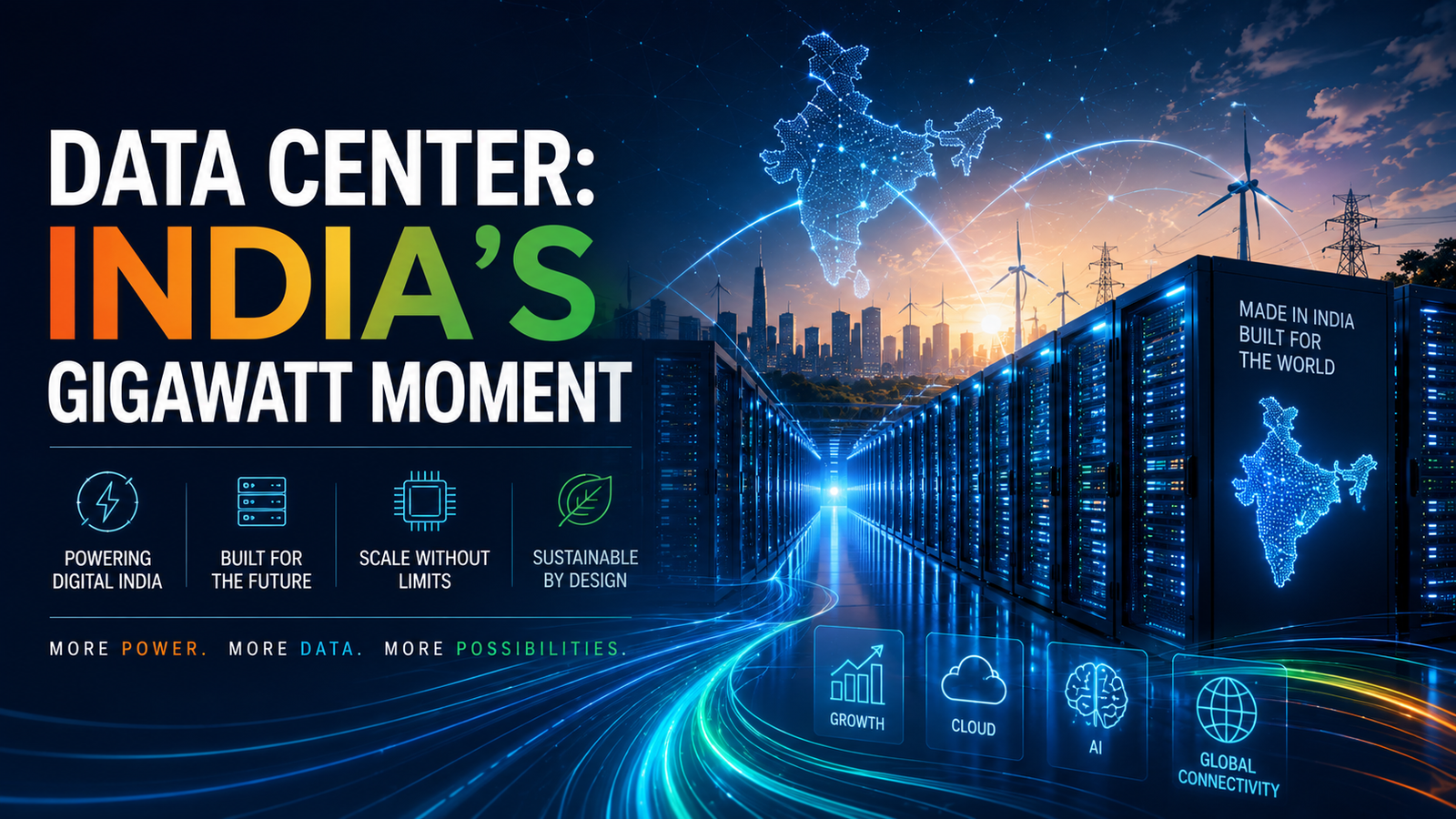
Fiscal 2025–26 was the year India's data centre industry stopped thinking in megawatts and started thinking in gigawatts — rewriting the country's digital infrastructure story at a scale and speed that few had anticipated
For most of the past decade, India's data centre industry was measured in hundreds of megawatts, a few dozen facilities clustered around Mumbai and Chennai, and a steady but unremarkable march of enterprise colocation deals. Fiscal 2025–26 shattered that frame entirely. Hyperscalers announced investments measured in billions of dollars and gigawatts of capacity. Indian conglomerates — Reliance, Tata, Adani, Hiranandani — pivoted from their core industries to become digital landlords at breathtaking scale. A Supreme Court ruling streamlined environmental approvals. A draft National Data Centre Policy signalled potential 20-year tax exemptions. And an AI compute hunger so acute that it rendered the old vocabulary of the industry obsolete. India's data centre market did not just grow in 2025–26. It was fundamentally transformed.
The Global Picture: $489.5 Billion and Accelerating
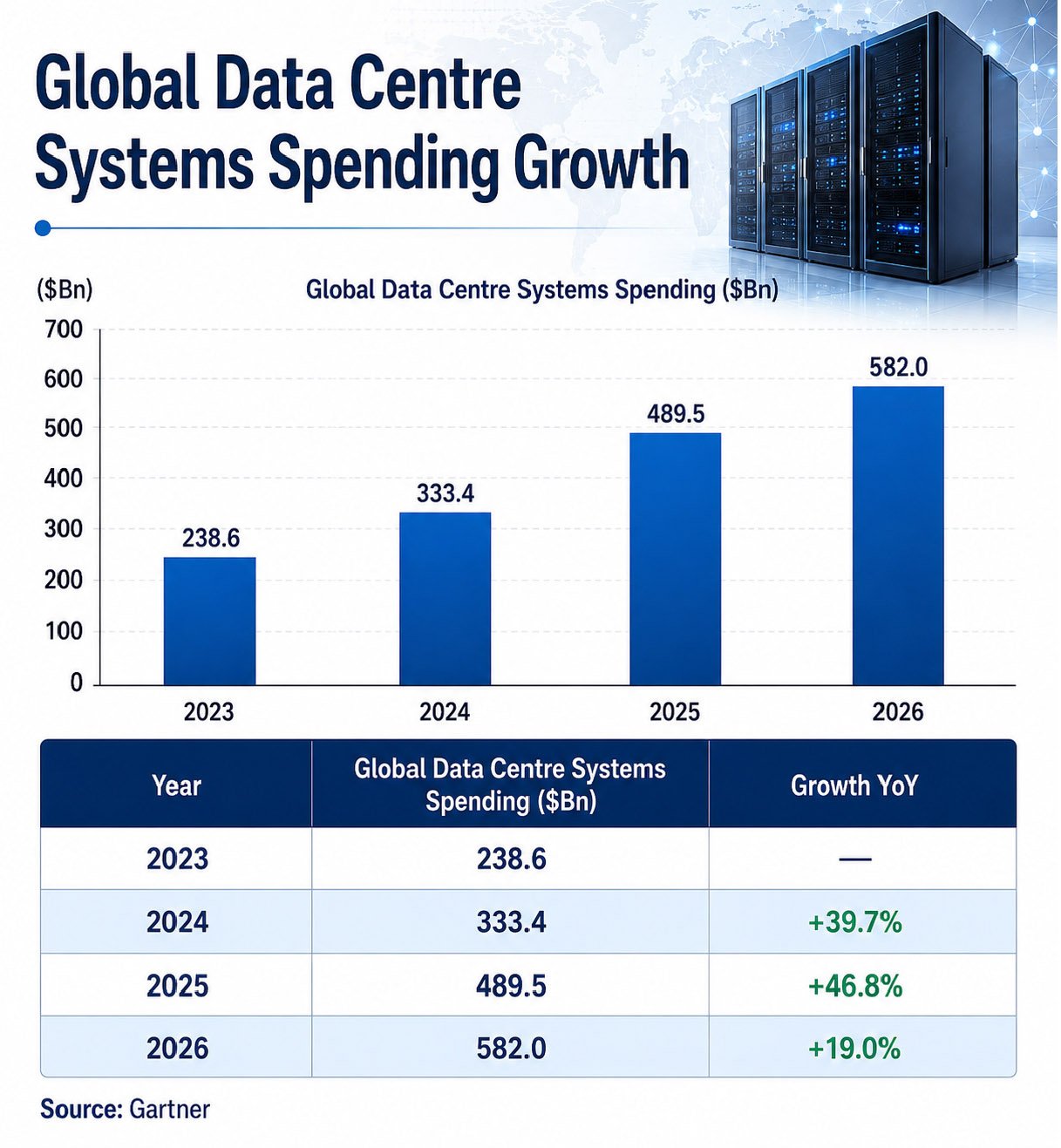
The data centre industry globally entered a period of growth unlike anything in its history in fiscal 2025–26, driven almost entirely by the infrastructure demands of generative AI. Worldwide data centre systems spending — covering servers, storage, networking, and associated software — reached $ 489.5 billion in 2025, up 46.8 percent from $ 333.4 billion in 2024, according to Gartner. The firm projects spending to grow a further 19 percent in 2026, surpassing $ 582 billion — a trajectory it describes as outpacing global GDP growth by a multiple. Total global data centre market value, including colocation, managed services, and infrastructure, is estimated at $ 386.71 billion in 2025 and projected to reach $ 1.1 trillion by 2035 at a CAGR of 11.06 percent, according to Precedence Research.
The four largest hyperscalers — Microsoft, Google, Amazon, and Meta — collectively planned to spend over $ 370 billion on data centre infrastructure in 2025, up from $ 244 billion in 2024, according to Synergy Research Group data. As of Q1 2025, there were 1,189 large hyperscale data centres globally, with 504 additional facilities in planning and construction. McKinsey projects $ 6.7 trillion in cumulative capital expenditure will be required globally between 2025 and 2030 to meet data centre demand, with $ 5.2 trillion dedicated specifically to AI infrastructure. India sits at the intersection of this global investment wave — a market offering low construction costs, a large digital user base, data sovereignty mandates, and geopolitical alignment with the West — making it one of the most actively courted data centre destinations in Asia-Pacific.
India's Market: From Megawatts to Gigawatts
India's data centre market was valued at $ 8.94 billion in 2025 and is projected to reach $ 31.36 billion by 2035 at a CAGR of 13.37 percent, according to Astute Analytica. Gartner's India-specific data centre systems spending data provides a sharper near-term lens: data centre systems spending in India is projected to record the highest annual growth rate of any IT segment in 2026, rising 20.5 percent — continuing to outpace all other categories even as it moderates from 29.2 percent growth in 2025, according to Gartner's November 2025 India IT Spending Forecast.
The physical scale of the transformation is equally striking. India's total operational data centre capacity reached approximately 1,520 MW of IT load by the end of 2025 — a record-breaking supply addition of 387 MW in a single year, more than double the 191 MW added in 2024, according to industry data from Savills and JLL. India's IT load capacity totalled 1.4 GW as of Q2 2025, according to S&P Global Market Intelligence 451 Research, with another 1.4 GW of new capacity already under construction. Government projections, cited by MoS MeitY Jitin Prasada, target an expansion of this capacity by 4–5x by 2030 — implying a trajectory toward 6–9 GW of installed capacity within the decade.
Mumbai continues to lead, commanding over 52 percent of total installed capacity, anchored by its submarine cable landing infrastructure and established business ecosystem. Chennai is cementing its position as the second-largest hub with close to 20 percent market share, driven by new cable landings including MIST. Hyderabad is emerging rapidly as a third major centre, with Google's gigawatt-scale investment in Visakhapatnam and multiple state-level incentive schemes attracting both global and domestic operators. The cost to build a megawatt of capacity in India is estimated at $ 6.8 million — significantly below $ 8–10 million in developed markets — making India structurally competitive on economics alone.
The Investment Wave: Billions Committed in a Single Year
Fiscal 2025–26 saw an investment wave into Indian data centre infrastructure that had no precedent in the country's technology history. India attracted approximately $ 14.7 billion in data centre investments between 2020 and April 2025 in total; a comparable volume was committed in fiscal 2025–26 alone, as global and domestic players raced to secure capacity ahead of AI demand.
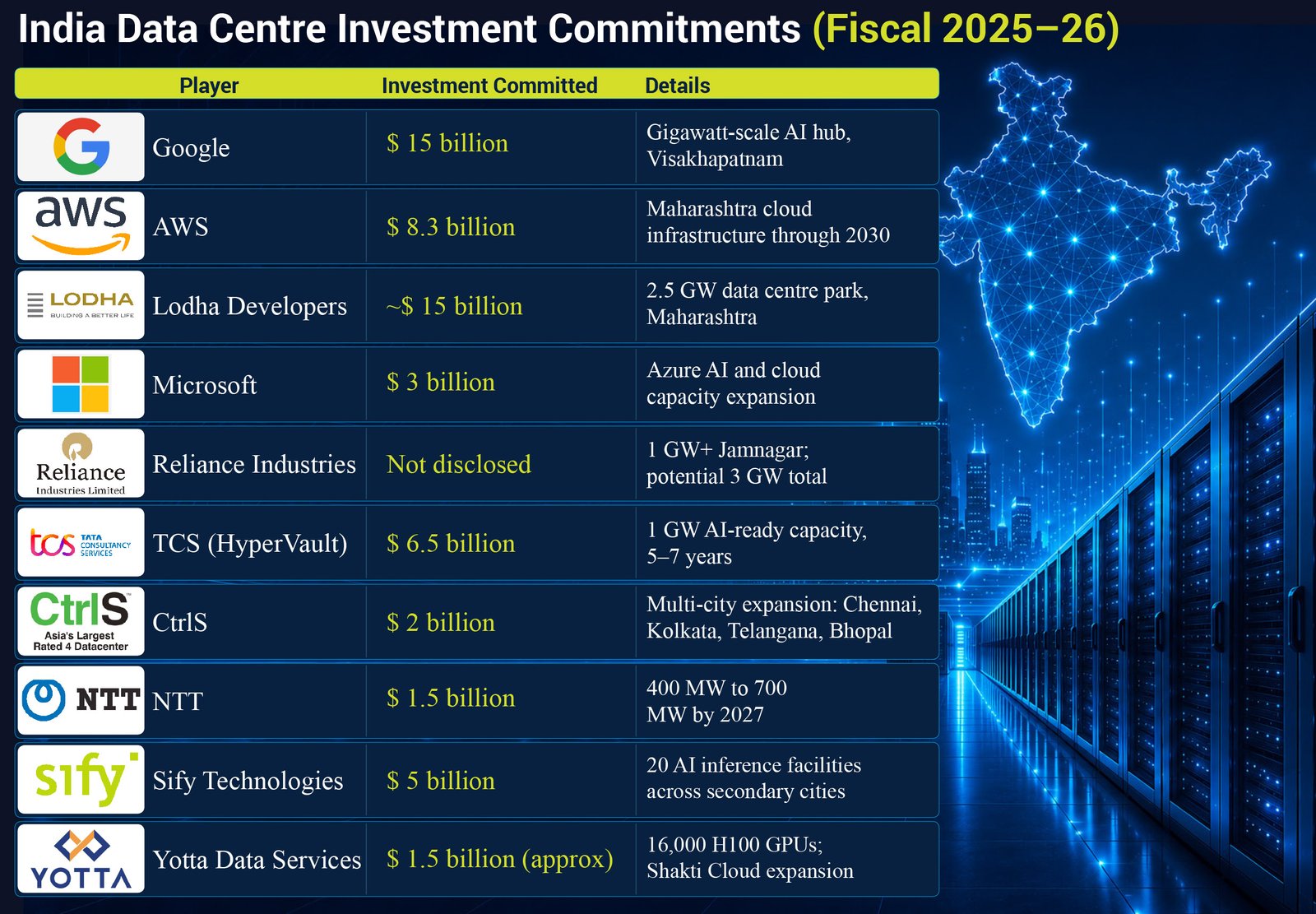
Microsoft committed $ 3 billion to expand Azure AI and cloud capacity in India, with its Hyderabad cloud region — comprising three availability zones — set to go live in mid-2026. AWS announced plans to invest $ 8.3 billion in Maharashtra through 2030, reinforcing its position as the largest cloud operator in the country. Google announced $ 15 billion for a gigawatt-scale AI hub in Visakhapatnam — projected to be among the most powerful AI infrastructure facilities in Asia — alongside a dedicated cloud region developed with Reliance in Jamnagar.
On the domestic side, the scale of ambition was equally dramatic. Reliance Industries is building what it describes as a gigawatt-scale data centre in Jamnagar, Gujarat, with potential for eventual expansion to 3 GW, powered by a dedicated 6 GW solar project. TCS established HyperVault — a dedicated subsidiary targeting 1 GW of AI-ready data centre capacity over five to seven years, requiring an estimated $ 6.5 billion investment. OpenAI confirmed TCS as its first customer for HyperVault, committing 100 MW of initial capacity as part of the global Stargate initiative. Lodha Developers — marking the most striking pivot of the year — committed approximately Rs 1.3 lakh crore (around $ 15 billion) for a 2.5 GW data centre park in Maharashtra, creating over 16,000 jobs. CtrlS committed $ 2 billion for a multi-city expansion plan covering Chennai, Kolkata, Telangana, and Bhopal. NTT announced plans to invest $ 1.5 billion to double its IT load capacity from 400 MW to 700 MW across 30 data centres by 2027.
Policy Architecture: The Regulatory Tailwinds
India's regulatory environment shifted decisively in favour of data centre investment in fiscal 2025–26. The DPDP Act, 2023's enforcement framework — which mandates that sensitive personal data of Indian users be stored within the country — gave global hyperscalers and enterprises the legal clarity they needed to commit long-term capital to Indian infrastructure. MeitY Naresh Goyal stated that with DPDP rules now published, "global cloud providers, hyperscalers, and enterprises have confidence to invest in long-term infrastructure like data centres."
The draft National Data Centre Policy 2025 proposed 20-year tax exemptions for data centre developers, single-window clearances, and fiscal incentives under the Data Centre Incentivization Scheme (DCIS). The Supreme Court's August 2025 ruling streamlined environmental approvals for projects exceeding 20,000 square metres through State Environment Impact Assessment Authority processes — a bottleneck that had previously delayed large projects by months. State governments ran parallel incentive programmes: Telangana signed MoUs covering hundreds of millions of dollars in investment; Maharashtra committed land allocation and reduced power tariffs; Andhra Pradesh's Data Centre Policy targets an additional 200 MW of capacity.
The government's own IndiaAI Mission GPU procurement contributed directly to data centre demand — with over 38,000 GPUs onboarded at subsidised rates, the mission created a sustained institutional customer base for colocation and managed AI infrastructure services.
Key Players: A Market in Full Expansion
India's data centre competitive landscape in fiscal 2025–26 was defined by aggressive capacity expansion across all tiers — global hyperscalers, international colocation operators, Indian IT conglomerates, and homegrown data centre specialists.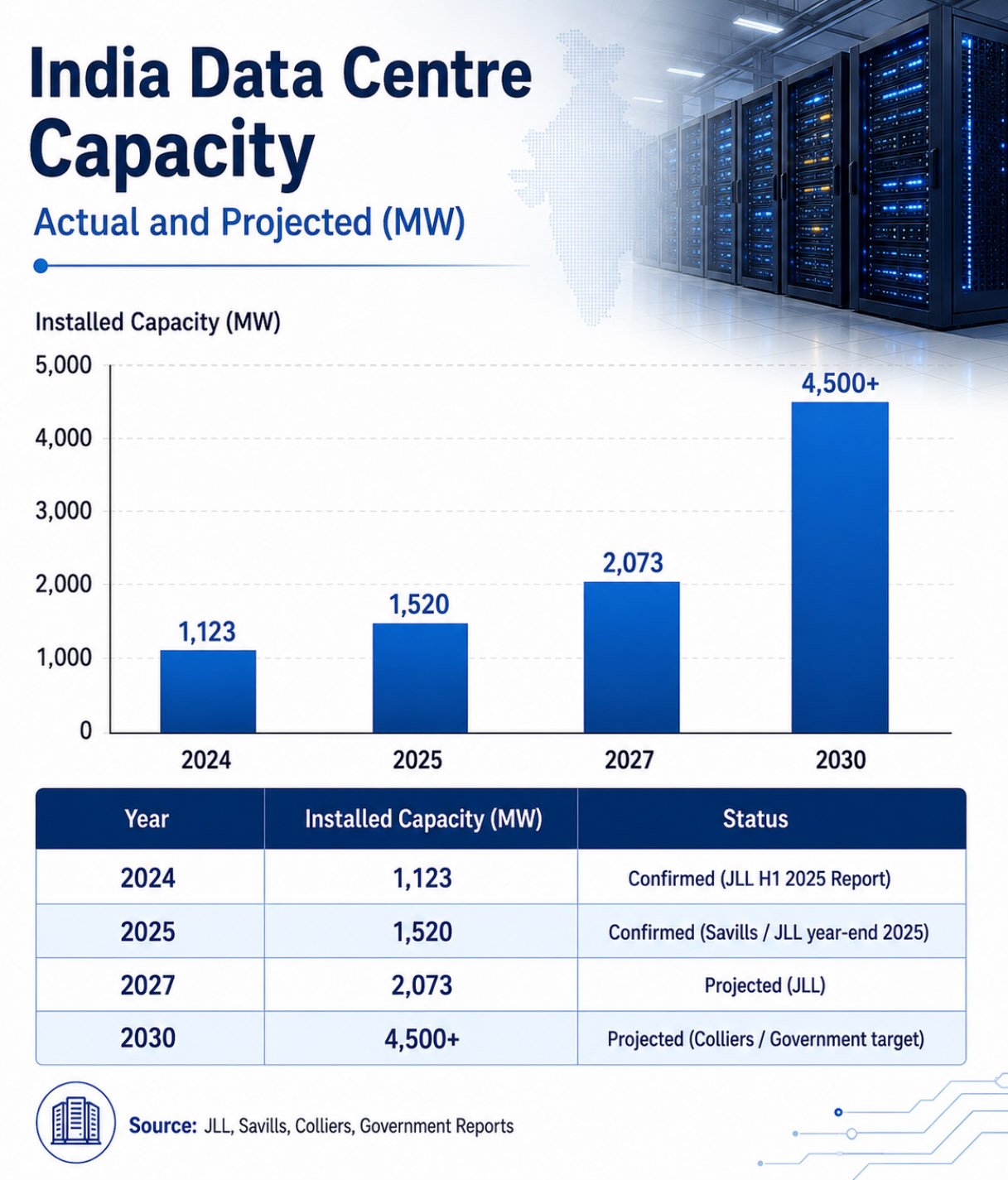 Among global operators, NTT Data led with 292 MW of live IT load in July 2025, with plans to reach 400 MW across new campuses in Noida, Hyderabad, and Bengaluru within 18–24 months. STT GDC (ST Telemedia Global Data Centres) remained a major operator; in February 2026, KKR and Singtel agreed to acquire an 82 percent stake in STT GDC, in a transaction reflecting strong investor confidence in Asia-Pacific digital infrastructure. Equinix opened its CN1 facility in Chennai in 2025, bringing its AI-ready colocation capabilities to India's southern corridor. AdaniConneX, the joint venture between Adani Enterprises and EdgeConneX, continued developing hyperscale facilities, with its 100 MW Chennai campus anchoring its southern India strategy.
Among Indian operators, Yotta Data Services (Hiranandani Group) led the pivot to AI infrastructure, procuring 16,000 Nvidia H100 GPUs for its Shakti Cloud with plans to scale to 32,768 units, and operating Asia's largest Tier-4 certified data centre at NM1 in Navi Mumbai. CtrlS Datacenters commissioned its Kolkata DC1 facility, inaugurated its Chennai campus with a $ 482 million investment, and signed an MoU with the Telangana government for a 400 MW AI-focused data centre cluster. Sify Technologies announced a $ 5 billion investment to expand Indian AI data centres, planning 20 AI inference facilities across secondary cities — a strategy that positions Sify as the most geographically distributed domestic operator in the country. Nxtra Data (Bharti Airtel), operating 14 data centres with 200 MW capacity, committed $ 600 million to further expansion. CapitaLand Investment reported the first close of its India-focused data centre fund at approximately SGD 150 million, acquiring minority stakes in three Indian data centre assets.
The Edge and the Sustainable Shift
Two structural trends ran alongside the headline investment activity. Edge computing emerged as a significant growth vector — ICRA estimated India's edge data centre capacity could triple from 60–70 MW in 2024 to nearly 200–210 MW by 2027, driven by 5G rollout and IoT demand. Facilities measuring under 5 MW are being deployed in tier-2 cities including Ahmedabad, Kochi, and Visakhapatnam, extending digital infrastructure to regions that previously had none.
Sustainability became a genuine commercial differentiator rather than a reporting obligation. Green-certified data centres currently account for 25 percent of India's total inventory but are projected to reach 30–40 percent by 2030, according to Colliers. Renewable energy PPAs — offering round-the-clock power from solar and wind — can reduce operating expenses by up to 30 percent versus grid tariffs, creating a direct economic incentive alongside environmental value. Immersion cooling and direct-to-chip liquid cooling are being deployed in high-density AI facilities, with operators like Digital Connexion running Chennai facilities with zero water dependency. Power use effectiveness (PUE) across India's data centre stock is expected to decline over the next five years as hyperscaler efficiency standards propagate across the market.
Power and Sustainability: The Critical Constraint
India's data centre boom has surfaced a challenge that capital alone cannot solve: power. As the country's installed data centre capacity expands from 1.5 GW toward a 9 GW target by 2030, data centres are projected to consume approximately 3 percent of India's total electricity by 2030, up from under 1 percent currently, according to the Institute for Energy Economics and Financial Analysis. Energy costs already account for approximately 65 percent of data centre operating expenses, according to S&P Global's September 2025 India data centre report — making power availability, pricing, and procurement strategy as consequential as capital investment decisions.
Renewable energy Power Purchase Agreements have emerged as the preferred solution. Digital Edge signed an 83 MW solar PPA with Hexa Climate Solutions in February 2026 to power the first phase of its 350 MW AI-ready hyperscale campus in Navi Mumbai — expected to offset approximately 100,000 tonnes of CO2 annually. Water scarcity is an equally pressing constraint: cooling a 1 MW data centre load requires an estimated 25.5 million litres of water annually, according to Uptime Institute data cited by S&P Global — a figure that puts India's water-stressed cities like Chennai and Bengaluru under significant operational risk as capacity scales toward gigawatt levels. Operators are responding with liquid cooling, immersion cooling, and zero-water-dependency facility designs — but the pace of technology adoption must match the pace of capacity addition if India's data centre ambition is to be realised sustainably.
The Road Ahead: From 1.5 GW to 9 GW
India's data centre capacity stood at approximately 1.5 GW at the close of fiscal 2025–26. The government projects this will expand to 9 GW by 2030 — a sixfold increase in under five years. More than 5 GW of additional IT load capacity is expected from pipeline projects and investment announcements already made, according to S&P Global. Over 95 percent of the capacity increase is expected to come from leased colocation and wholesale facilities rather than enterprise self-builds, as demand from hyperscalers, AI companies, and enterprises continues to outpace the ability of any single operator to self-fund at the required scale.
The economics of the Indian data centre opportunity are compelling: construction costs below those of any comparable market in Asia-Pacific, a 1.4 billion-person digital user base, data sovereignty mandates that make domestic infrastructure non-negotiable for regulated sectors, and a government that has elevated data centre development to strategic national infrastructure.
The challenge is execution — power, land, environmental clearances, and talent at the speed that the investment pipeline demands. India's data centre industry entered fiscal 2025–26 thinking in megawatts. It will need to deliver gigawatts. The commitments are made. The race is on.