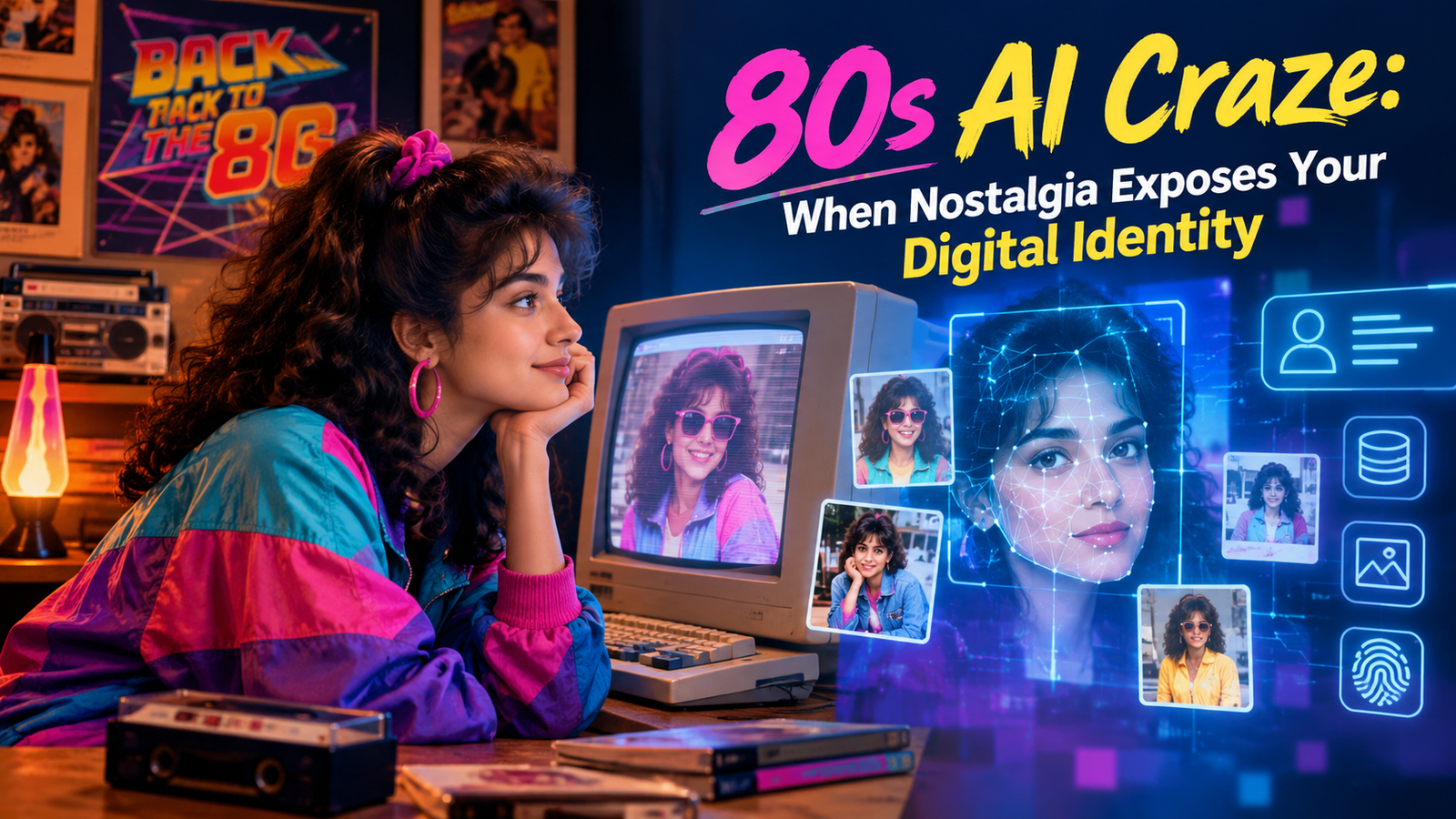
The viral 80s AI photo trend looks harmless enough: upload a selfie, and generative AI recreates you with vintage hairstyles, retro clothing, period lighting, and authentic film-grain texture. The trend spread rapidly across Instagram and other platforms in September 2026, amplified by celebrities and public figures sharing their own retro avatars.
There's no single, reliably confirmed originator. Available reporting suggests the trend emerged organically through user-generated prompts and social sharing rather than from one identifiable creator, with early versions circulating internationally before exploding in India.
The technology behind it is far more sophisticated than an ordinary photo filter. Generative models preserve recognizable facial characteristics while fully reconstructing hair, clothing, pose, lighting, background, and photographic texture — a capability that reveals just how much visual information can be extracted from what looks like an ordinary snapshot.
A single high-resolution face contains measurable characteristics: facial geometry, eye spacing, nose and mouth structure, skin texture, expression, and pose. Computer-vision systems can convert these characteristics into representations usable for recognition or classification — the same underlying technique behind biometric identification systems.
An important distinction, however: a photograph doesn't reliably reveal someone's personality, intentions, or character. AI can classify visible expressions or behavioral cues, but inferring someone's inner traits or future behavior from facial appearance alone remains scientifically unreliable — a caution worth remembering as AI-generated "insights" about people proliferate.
The real privacy concern isn't that every AI-photo app is secretly harvesting biometrics. It's that users routinely upload highly identifying images to platforms without understanding data retention periods, secondary use, permissions, metadata handling, or basic security practices — a gap serious enough that police have warned against unknown apps and suspicious links exploiting the trend's popularity.
The larger lesson is simple but easy to forget mid-scroll: your face is no longer just a photograph — it's machine-readable identity data. Before chasing the next viral AI transformation, it's worth asking three questions: Who receives my image? What can they derive from it? And what happens to it afterward?