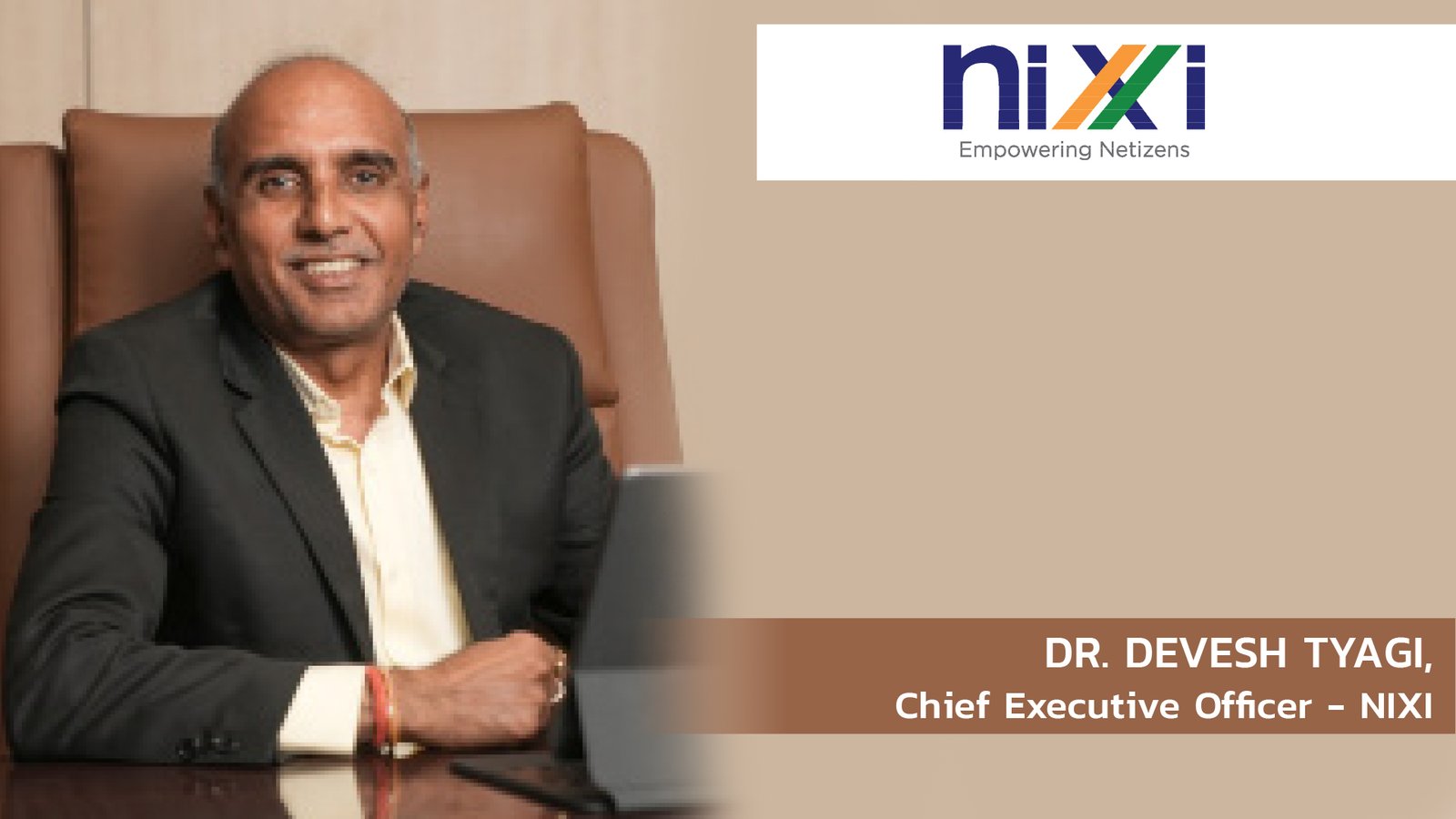
Dr. Devesh TyagiChief Executive Officer - NIXI
““As per recent estimates, India has over 1 billion Internet users, and the next phase of growth will largely be driven by non-English speakers. The push for vernacular domains is aimed at bridging the digital divide and making the Internet more inclusive.” ” |
For over two decades, the National Internet Exchange of India (NIXI), under the aegis of the Ministry of Electronics and Information Technology, has been at the forefront of building and strengthening India’s digital backbone. From enabling seamless and efficient Internet exchange through its expansive network of IXPs to strengthening India’s digital identity with millions of active ‘.in’ domains, NIXI has consistently fostered innovation, trust, and scale in the country’s Internet infrastructure. As India’s digital ecosystem continues to expand, NIXI remains steadfast in its commitment to powering the nation’s digital future through robust infrastructure, enhanced cybersecurity frameworks, and a vision of inclusive Internet access for all.
TWO DECADES OF BUILDING INDIA’S INTERNET BACKBONE
For over two decades, the NIXI has been working towards enabling a safe, secure, efficient, and inclusive Internet ecosystem in the country. It began as an Internet Exchange service provider and subsequently expanded its scope by adding two key services - the .in & registry and the National Internet Registry.
In the domain space, NIXI is supporting India’s digital identity with over 3.9 million active .in domains and is steadily progressing toward the milestone of 5 million. In terms of country code top-level domains (ccTLDs), India is ranked among the top ten globally.
As part of its continued commitment to strengthening cybersecurity in the financial sector, NIXI is facilitating the migration of all banks’ net banking platforms to the exclusive ‘.bank.in’ domain, in line with the mandate issued by the Reserve Bank of India. To operationalize this initiative, the Institute for Development and Research in Banking Technology has been designated as the exclusive registrar by NIXI. This strategic measure ensures regulated access, rigorous verification processes, and enhanced cybersecurity for digital banking platforms, significantly reducing risks including online financial fraud.
POWERING INDIA’S CORE INTERNET INFRASTRUCTURE
Across the country, NIXI has established 79 Internet Exchange Points (IXPs), enabling efficient local routing of data between ISPs. This reduces foreign bandwidth use, lowers latency, and enhances overall user experience. Additionally, the presence of over 20+ Content Delivery Networks (CDNs) within NIXI’s ecosystem highlights the increasing localization of data and content in India. NIXI continues to expand its infrastructure footprint to cater to the growing demands of the country, particularly in Tier 2 and Tier 3 cities. This expansion plays a vital role in strengthening Internet resilience by ensuring continuity of services even during global disruptions.
NIXI is also facilitating domain name availability in 22 Indian languages to improve accessibility for non-English users, aligning with the vision of ‘Internet for all’. The Indian Registry for Internet Names and Numbers (IRINN) provides allocation and registration services for Internet Protocol addresses - both IPv4 and IPv6 - across the country.
India is among the global leaders in IPv6 adoption, with approximately 78.78% penetration, which is critical given the near exhaustion of IPv4 resources. Through IRINN, NIXI supports networks and enhances digital autonomy and scalability. IPv6 is instrumental in enabling future-ready infrastructure by supporting billions of connected devices across sectors such as smart cities, healthcare, and digital governance.
DRIVING A SECURE AND INCLUSIVE INTERNET
NIXI has undertaken multiple initiatives to foster a secure and inclusive Internet ecosystem in India. One of its major achievements has been accelerating IPv6 adoption, positioning India as a global leader in this domain.
NIXI has also prioritized the .in domain, with a target of reaching 5 million users. The .in domain not only strengthens India’s digital identity but also plays a crucial role in enabling secure digital governance for government platforms, educational institutions, and businesses.
Through the NIXI Academy, the organization is conducting training and capacity-building programs focused on IPv6 adoption, digital literacy, and cybersecurity best practices, thereby strengthening the broader digital ecosystem.
In addition, the NIXI is contributing to global Internet governance capacity building through initiatives such as the Internet Governance Internship and Capacity Building Scheme, enabling Indian participants to engage in international policy and technical discussions at platforms like the Internet Corporation for Assigned Names and Numbers (ICANN).
THE ROAD AHEAD: BUILDING A RESILIENT DIGITAL FUTURE
• NIXI plans to further expand its digital infrastructure by establishing additional IXPs, particularly in underserved and rural regions, to enhance Internet penetration and improve service delivery.• It will continue to promote wider IPv6 adoption through awareness campaigns and technical training initiatives. Efforts are also underway to drive greater adoption of .in and domains, especially in regional languages, to foster digital inclusivity and encourage local content creation.
• NIXI is formulating Internet resilience policy to ensure uninterrupted access to critical digital services, even in the event of global connectivity disruptions.
• To strengthen India’s cybersecurity ecosystem, NIXI - along with the office of the Controller of Certifying Authorities under MeitY - is working on establishing infrastructure for a WebTrust-compliant SSL Certifying Authority in India. Currently, SSL certificates are predominantly issued by foreign entities; this initiative will enhance trust in digital transactions, reinforce India’s digital sovereignty, and enable globally recognized SSL certificates issued within the country.