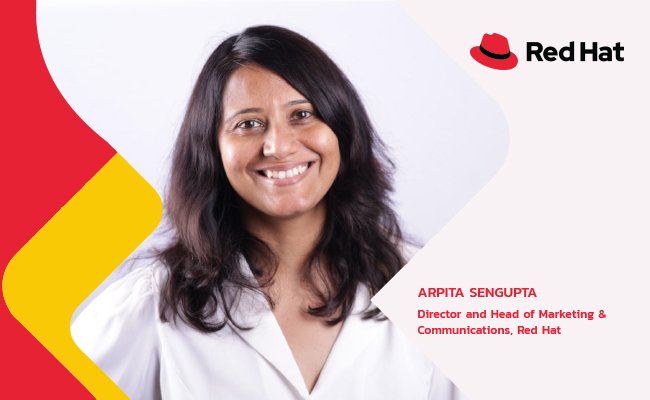
Arpita Sengupta
Director and Head of Marketing & Communications, Red Hat
AI REDEFINING BRANDING & MARKETIING STRATEGY
AI is fundamentally redefining how brands engage with their audiences by enabling scale, precision, and personalization like never before.
“At Red Hat, we see AI as a powerful ally that helps marketers decode consumer behavior, spot patterns across massive data sets, and respond in real time with relevant messaging,” says Arpita Sengupta, Director and Head of Marketing & Communications at Red Hat. “AI empowers us to understand micro-trends across regions, identify which content resonates where, and deploy highly personalized experiences at scale. For example, using AI-powered data models, we can tailor our communications strategy to different verticals and regions, ensuring that our storytelling reflects both the technical depth and local relevance expected by our stakeholders.”
In the B2B space, especially in the enterprise IT sector, AI allows marketing to move from being a support function to a growth driver—proactively identifying what Red Hat’s audiences care about, aligning with their business goals, and demonstrating how open source solutions like Red Hat’s drive real-world impact.
Some of the most compelling campaigns today blend AI’s capabilities with human ingenuity. Red Hat’s own approach to content localization provides a great example. “We have implemented an internal generative AI workflow to speed up translation processes. This frees our creative teams to focus on value-added storytelling and cultural customization—areas where AI still falls short.
The message is clear: when humans guide AI with purpose, the result is marketing that’s more inclusive, scalable, and impactful.”
CONSTRAINTS TO AI USAGE IN MARKETING
AI lacks intuition, empathy, and moral reasoning. It cannot understand tone, interpret satire, or navigate the emotional undercurrents that often define powerful brand storytelling. Especially in a market like India—where humor, context, and symbolism can vary dramatically from one region to another—relying on AI alone can lead to messaging that feels tone-deaf or generic.
“At Red Hat, we have seen that even the best AI models need thoughtful human review to ensure that content is inclusive, accurate, and aligned with our brand’s values. It’s not just about data—it’s about delivering meaning, and only humans can truly do that,” says Arpita.
At the same time, AI can deliver insights, optimize workflows, and automate content delivery—but it cannot replicate the depth of human creativity, empathy, or cultural understanding. Red Hat firmly believes that creativity and intuition remain the backbone of impactful marketing.
“AI might tell us what’s trending, but only a human can tell a story that builds trust and emotional resonance. In a culturally complex market like India, this becomes even more critical. Our audiences don’t just want content—they want context. That’s where human marketers step in: interpreting data in ways that are empathetic, inclusive, and imaginative,” points out Arpita. “We encourage our teams to see AI as a partner in the creative process—supporting ideation, but never replacing the human spark that drives brand differentiation.”
A COLLABORATIVE, INNOVATIVE APPROACH TO AI
Red Hat’s open source culture is not just a technology model—it’s a way of thinking that permeates every part of the organization, including marketing. Its belief in transparency, collaboration, and community drives how Red Hat approaches AI.
“We don’t see AI as a proprietary black box—we view it as a tool to be explored, questioned, and improved upon collectively,” says Arpita. “For example, our in-house generative AI workflows reflect this ethos. We use AI not just to automate, but to augment—freeing up our teams to focus on creativity, strategic planning, and deeper engagement. And because our systems are grounded in open hybrid cloud architectures, we ensure that the data powering our insights is secure, ethical, and scalable.”
Red Hat is deeply committed to leveraging AI and data-driven insights to better understand market dynamics in India. Its open source culture empowers the brand to collaborate widely, sharing knowledge and best practices to drive innovation.
“We are using AI-driven predictive analytics to anticipate shifts in technology adoption, helping us align our go-to-market strategies with where our customers and partners are headed. This includes everything from analyzing trends in hybrid cloud adoption to understanding regional variations in IT infrastructure needs. By combining these insights with human expertise, we’re better able to serve India’s diverse and rapidly evolving IT landscape,” explains Arpita.