As the cybersecurity landscape evolves in response to breakthrough technologies, organizations face a dual threat: the impending obsolescence of traditional encryption due to quantum computing and the rise of sophisticated AI-driven fraud. While many enterprises currently trust that their encrypted data remains secure, industry experts caution that this confidence may be short-lived in the face of advancing adversarial capabilities.
With significant progress in quantum computing, a growing number of threat actors are adopting a “harvest now, decrypt later” strategy. This approach involves the exfiltration and long-term storage of encrypted data with the intent to decrypt it once quantum systems become sufficiently powerful to compromise current cryptographic standards such as RSA and ECC. Sensitive information transmitted today—including financial records, intellectual property, protected health information, and classified government communications—could become vulnerable to exposure in the future.
In response to this emerging risk, cybersecurity leaders are accelerating the adoption of post-quantum cryptography (PQC), a new class of encryption algorithms engineered to withstand quantum-based attacks. In parallel, the integration of Zero Trust architectures and hybrid cryptographic models is enabling organizations to enhance security postures while ensuring interoperability with legacy infrastructure.
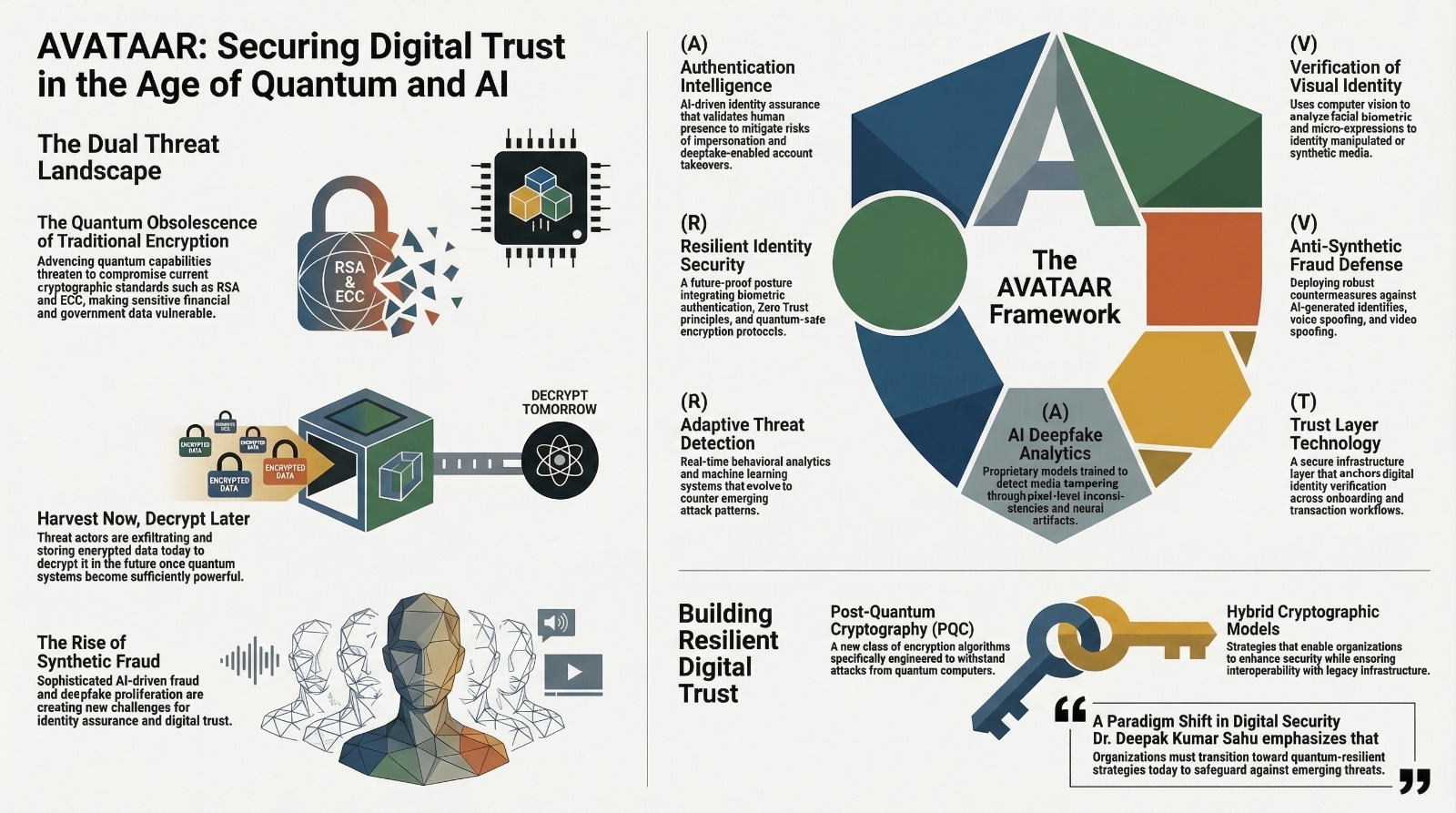
Dr. Deepak Kumar Sahu, Founder and CEO of FaceOff Technologies, emphasizes the urgency of preparing for a paradigm shift in digital security. “Quantum computing will fundamentally reshape the foundations of cybersecurity,” he stated. “It is imperative that organizations begin transitioning toward quantum-resilient strategies today. At FaceOff Technologies, we are engineering next-generation digital trust frameworks that converge post-quantum cryptography, AI-native identity assurance, and advanced deepfake detection to safeguard enterprises against both current and emerging threats.”
To operationalize this vision, FaceOff Technologies has introduced the AVATAAR Digital Trust Framework, a comprehensive, multi-layered security architecture purpose-built to counter synthetic identity fraud, deepfake proliferation, and advanced persistent cyber threats.
The AVATAAR Framework comprises the following core components:
● A – Authentication Intelligence: AI-driven identity assurance that validates human presence during digital interactions, mitigating risks associated with impersonation and deepfake-enabled account takeover.
● V – Verification of Visual Identity: Computer vision-based analysis of facial biometrics, micro-expressions, and video artifacts to identify manipulated or synthetically generated media.
● A – Anti-Synthetic Fraud Defense: Robust countermeasures against AI-generated identities, voice and video spoofing, and other synthetic fraud vectors.
● T – Trust Layer Technology: A secure infrastructure layer that anchors digital identity verification across transactions, communications, and onboarding workflows.
● A – AI Deepfake Analytics: Proprietary AI models trained to detect media tampering through pixel-level inconsistencies, lighting anomalies, and neural artifacts.
● A – Adaptive Threat Detection: Real-time behavioral analytics and machine learning systems that continuously evolve to counter emerging attack patterns.
● R – Resilient Identity Security: A future-proof security posture integrating biometric authentication, Zero Trust principles, and quantum-safe encryption protocols.
As quantum computing and generative AI continue to redefine the threat landscape, frameworks such as FaceOff’s AVATAAR represent a strategic imperative for organizations seeking to build resilient digital trust infrastructures. By addressing both the long-term risks of quantum decryption and the immediate challenges posed by synthetic fraud, FaceOff Technologies is positioning itself at the forefront of next-generation cybersecurity innovation.