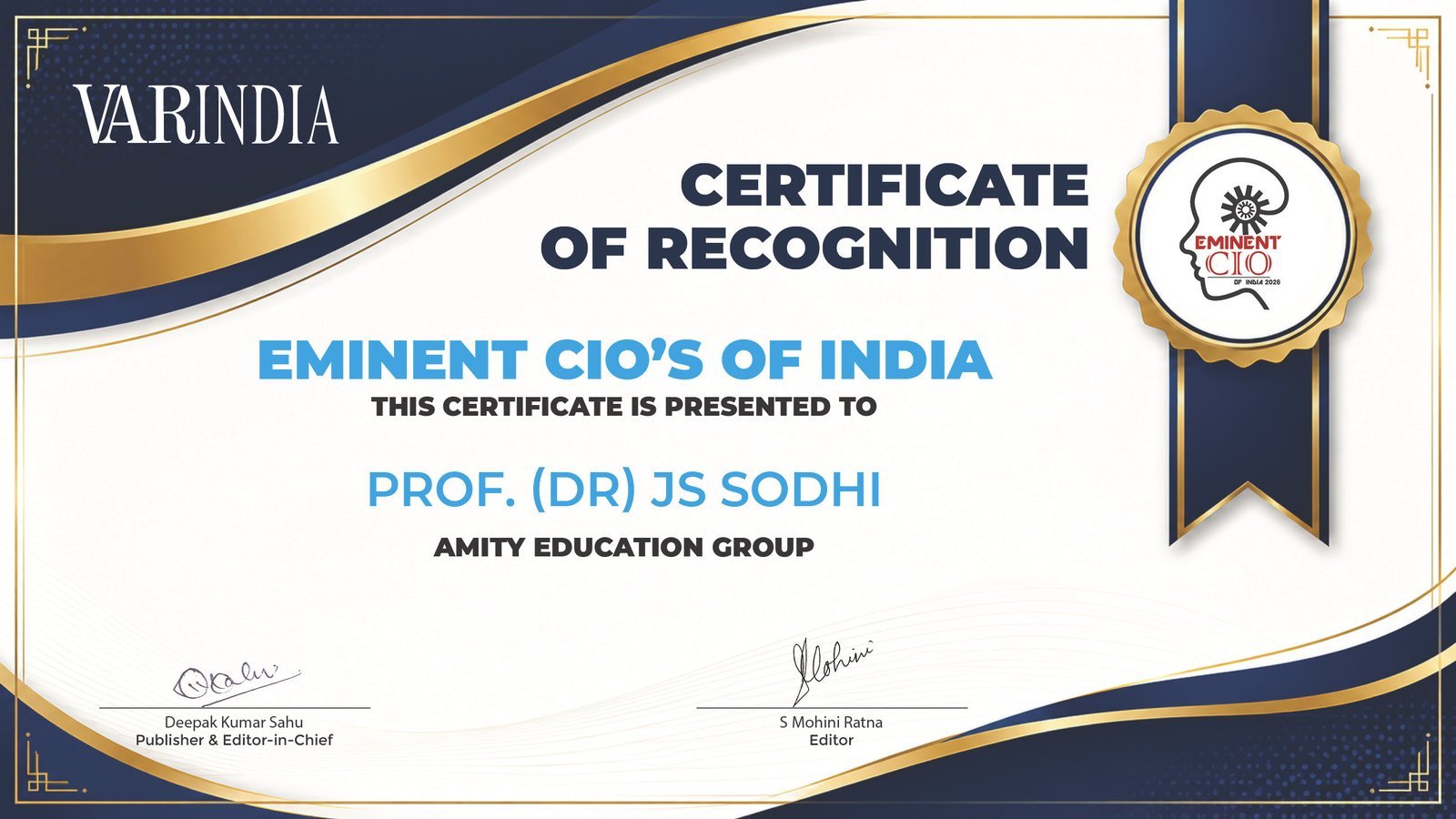
Eminent CIO's Of India 2026

Prof. (Dr) JS Sodhi
Group CIO & SR VP - Amity Education Group
As higher education evolves in an increasingly digital and AI-driven world, institutions must build technology ecosystems that enhance learning, strengthen governance, and support innovation. By investing in secure digital infrastructure, data-driven decision-making, cybersecurity, digital inclusion, and AI-led capabilities, educational institutions can create future-ready environments that empower students, faculty, researchers, and administrators while driving academic excellence.
Lifecycle IT Infrastructure & Operational Efficiency
We focus on maximizing the value of our technology investments by following a lifecycle approach to IT infrastructure. Strong backup and disaster recovery systems ensure business continuity, while advanced security measures such as Multi-Factor Authentication (MFA), MAC-based Wi-Fi registration, encryption, and firewalls provide secure and reliable access to university resources. As a result, IT investments deliver measurable benefits in operational efficiency, service quality, and overall institutional effectiveness.
Unifying Campuses via Smart Networking and ERPs
We are strengthening IT governance by building a modern and reliable digital infrastructure across all Amity University campuses. This includes centralized ERP systems, smart campus networking, learning management systems, data-driven quality monitoring, and performance measurement tools that help improve efficiency and decision-making.
Building an AI-Ready Academic Ecosystem
To prepare ourselves for the AI era, we have established the Amity Centre for Artificial Intelligence (ACAI) with high-performance computing facilities. Through the AI Centre of Excellence (CoE) and the vision of “AI for All,” we are promoting AI-based learning, research, innovation, and administration across all disciplines, helping build future-ready skills and capabilities.
Continuous Security Monitoring and DPDP Compliance
Cybersecurity remains a key priority. Our IT systems are monitored in real time through SIEM and SOC platforms to quickly identify and respond to security threats. Regular phishing awareness campaigns, employee training programs, phishing email detection systems, security audits, and Vulnerability Assessment and Penetration Testing (VAPT) help protect the university from cyber risks and strengthen overall security.
We also follow strict data protection practices to ensure that personal information is collected, stored, and used responsibly. Compliance with the Digital Personal Data Protection (DPDP) Act helps safeguard user privacy. Access to sensitive data is restricted to authorized users, and appropriate controls are in place to prevent misuse or unauthorized access. Digital inclusion is another important focus area. We continuously improve access to technology and develop user-friendly digital platforms that meet the needs of students, faculty, researchers, and staff from diverse backgrounds. Through these initiatives, we are creating a secure, innovative, and technology-driven environment that supports teaching, learning, research, and administration while building trust and ensuring the long-term success of the university.
E-Magazine
Certificate